

As an economist from Pakistan, I get asked a familiar question, especially given our deep economic troubles: If you could pick three policies to fix Pakistan, what would they be? It is an understandable question, but I want to start by questioning the question.
For decades, scientists and engineers have struggled with how to build intelligent systems that can solve hard problems - like recognizing a face. One option was to be completely prescriptive: spell out what a “normal” face looks like, then list every possible variation for every person. That path quickly hit a wall, and modern AI took a very different route. Instead of writing ever more complicated solutions, we built relatively simple systems with one critical property: iterative self-learning. The goal is not to hard-code the answers, but to build a kind of nervous system that figures out the right answers for itself over time.
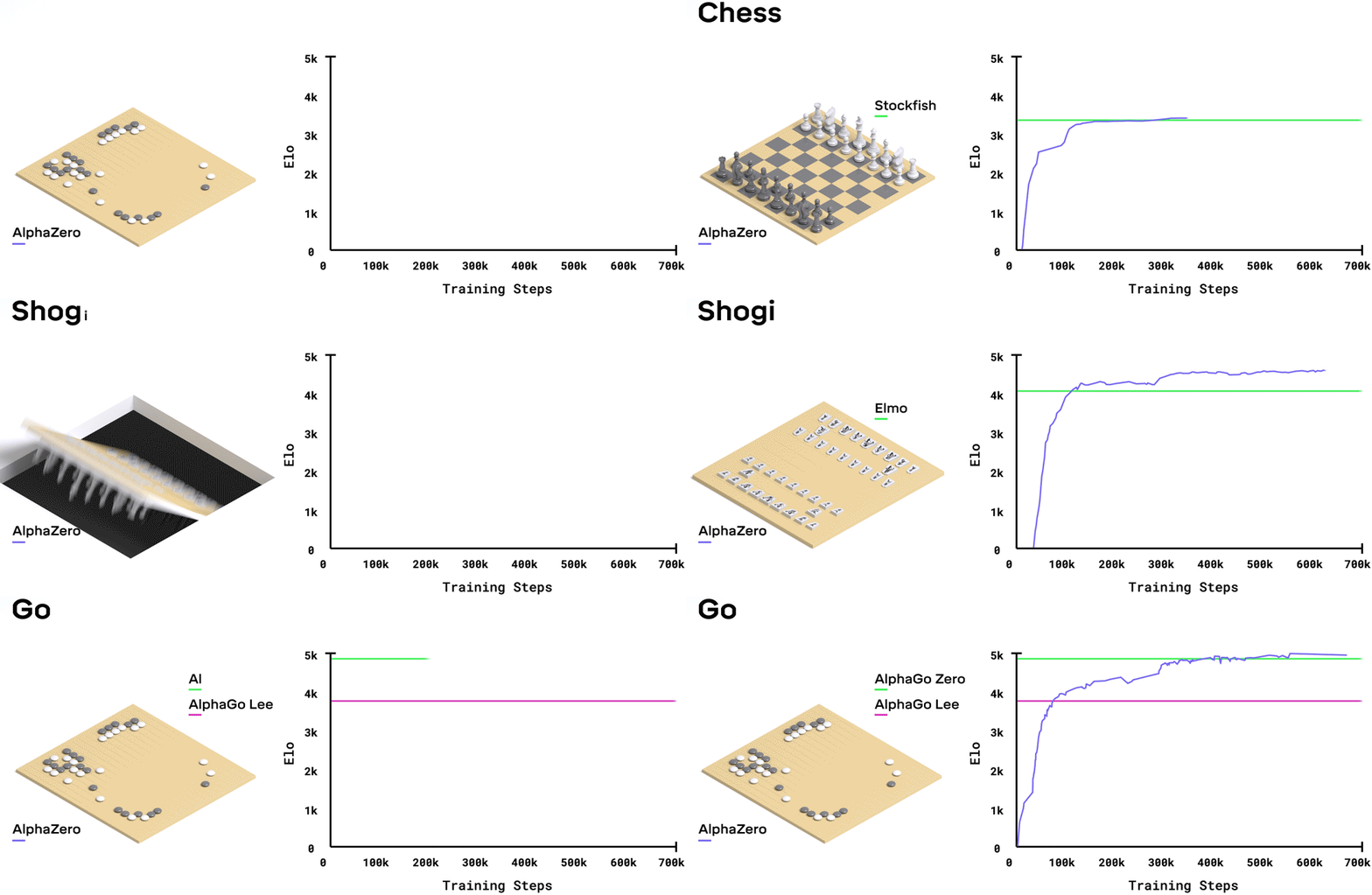
One of my favorite examples is DeepMind’s AlphaZero, an AI system that teaches itself to master complex board games and then beats the best human players. Its brilliance lies in its simplicity. You never tell it what a “good” chess move is; you only give it the rules of the game, and it learns the rest on its own. To me, that is what smart policy should aspire to: build a nervous system, grounded in first principles, that keeps learning better policy solutions over time. It is precisely this kind of nervous system that Pakistan lacks.
What would a self-learning nervous system for Pakistan look like? It should have three key ingredients. The first is data. AlphaZero generates its own data through self-play, then uses it to test existing strategies and discover better ones. We already live in an age of data. Interactions between students and teachers, doctors and patients, consumers and producers can all be digitized and “trained on” to improve incentives, learning and health outcomes, boost domestic productivity, and so on. That data is essential for any intelligent system should be obvious - yet Pakistan has failed even to conduct a census on time for decades.
The second key ingredient is an iterative learning-and-feedback mechanism. In AlphaZero, a deep neural network starts with a rough way of playing, then repeatedly improves by playing against itself, using the data from those games to update its internal strategy through backpropagation. Over time, bad ideas are discarded and better ones are reinforced. Pakistan desperately needs institutional capacity that works the same way: using real-world evidence to see what works, what needs fixing, and what is missing. That means building serious technical capacity across universities, think tanks, and government organizations. Instead, after decades of neglect, whatever capacity Pakistan once had has simply withered away.
The third ingredient is the most important one: choosing the human in the loop. As remarkable as AlphaZero is, none of it would exist if Google had not backed someone as capable as Demis Hassabis, a future Nobel laureate, and given him substantial resources and authority. This is where governments have stumbled badly. I have long argued that we must appoint highly competent people at the top of the decision-making chain and then give them the power and resources to get things done. Instead, far too often, outright quacks have been placed in some of the most critical policy roles. Pakistan can do much better. If you want to win the World Cup, you do not select your relative; you find a Wasim Akram, and let him bowl.
Pakistan’s potential is enormous - that is exactly what makes our current state so intolerable. As I argued in my previous post, the stagnant regimes of yesterday and today have run their course; you cannot escape crisis by running the same failed tricks again and again. What Pakistan needs now is a new nervous system - built on real data, genuine learning, and competent people trusted with real authority.
While I commend the insightful suggestions in this article, the critical discussion point remains one of implementation capacity and institutional willingness. Can Pakistan's current infrastructure and bureaucracy, which is demonstrably corrupted beyond any hope of reform and rendered utterly useless for effective policy execution, realistically execute policies, even those driven by highly competent appointees with genuine authority? Examples of successful, large-scale national fixes, such as the reforms that were seen in China and Cuba, demonstrate that foundational change often followed a profound systemic break. This raises a challenging but necessary question for our national dialogue; given the depth of the current mess and the compromised state of the delivery system, can Pakistan truly achieve the necessary reforms without first undertaking a fundamental, revolutionary restructuring of its governance?
Bashir Aziz makes an interesting point but this is not a chicken or egg situation. Our bureaucracy is headlessly headstrong and arbitrary because of the severely curtailed vision in our leadership. This puts us in a GIGO situation and thus no surprise that every policy framework eventually starts to stink.