

Petrol at Rs 30/litre in Pakistan sounds crazy. It is not. What is crazy is the policy failure that prevents it.
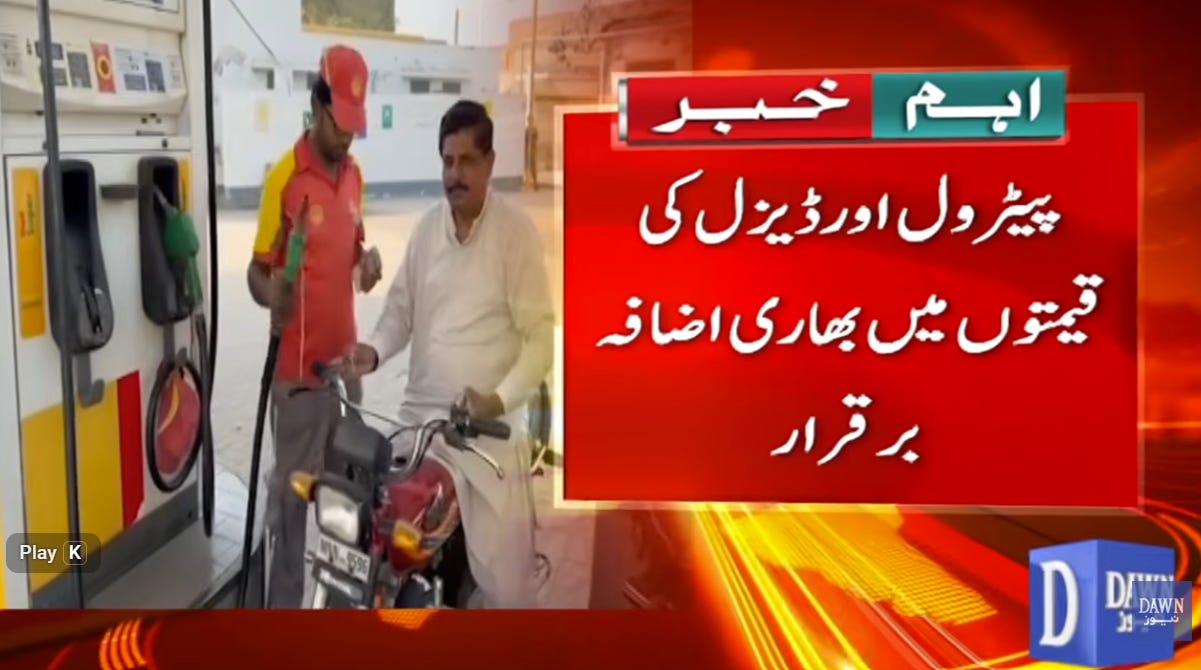
Petrol is around Rs 300/litre today, excluding government levy, here's how it can effectively be Rs 30/litre.
People do not consume petrol for its own sake; they use it to travel. The average Pakistani rides a motorbike. A fuel-efficient motorbike can travel about 60 km on one litre. An efficient electric scooter can travel about 30 km per kWh, so it needs only 2 kWh to cover the same 60 km.
What should 2 kWh cost in Pakistan? Pakistan is one of the best places in the world for solar, with an all-in LCOE cost of around 5 cents per kWh. The electricity cost is 10 cents, or Rs 30/litre of distance travelled! The Rs 30/litre calculation remains the same for cars.
The 300-versus-30 gap is the cost of bad policy. It reflects billions of dollars of saving that could instead finance EV infrastructure: charging, distribution, battery swapping, and smart pricing software etc. - boosting much-needed domestic investment.
Since solar is highly modular. You do not need massive scale to get reasonable efficiency. That creates business and employment opportunities for small domestic power producers. Instead, Pakistan leaned into large fossil-fuel plants financed by dollar-denominated borrowing and guaranteed returns.
Local firms face credit constraints, but solar creates a natural collateralizable cash flow through electricity sales to the grid. With the right regulatory framework, this could have unlocked large private domestic investment, and employment.
Battery swapping is another area where small local businesses could have emerged and scaled.
Electricity enables smart pricing. When solar supply is abundant, prices can fall, and poor households and firms can shift usage to cheaper hours - automatic demand stabilization.
Better air quality would mean longer, healthier lives and higher productivity. That is a growth multiplier.
Green technology industries could be developed domestically with the right industrial policy, easing balance-of-payments pressure while raising employment and investment.
Instead, Pakistan chose imported-fuel power plants, protected a backward-looking domestic auto sector, and raised electricity prices by burdening them with the fixed costs of those plants and heavy taxation, slowing EV adoption. Then came the net-metering fiasco, all to keep zombie power plants alive.
Pakistan’s energy policy may be the clearest example of a broken nervous system. I hope someone fixes it, because people are paying the price, 300-versus-30.
Sir, very well said. However, the analysis appears to rest on a significant ceteris paribus assumption—that business morality and ethical standards are functioning at a high level. In our context, unfortunately, the situation is quite the opposite, as reflected in our low rankings in these areas.
Moreover, policymaking often seems to be driven more by short-term public appeal than by long-term national interest. Therefore, alongside proposing a sensible solar policy, it is equally important to address governance and accountability issues on a priority basis. Would you agree?
Nicely said.